
The SunCooler™ as the Leading Off-Grid Heat Mitigation Strategy Through High-Velocity Psychrometric Cooling
The SunCooler™ is the only fully autonomous solar air handling HVAC system purpose-built to deliver powerful high-velocity turbulent airflow for real psychrometric cooling even when grid-tied HVAC systems fail during extreme heat waves and brownouts.
By combining exhaust, induction, nightflush, and destratification modes with onboard 36V AGM battery backup and three 575 W solar panels, the SunCooler provides continuous convective and evaporative cooling at the occupant level. No wiring. No electrical permits. Just drop it in and it works.
- High-Velocity Psychrometric Cooling: Massive turbulent airflow (up to 15,000 CFM) raises the effective temperature tolerance of workers by several degrees via convection and skin evaporation.
- Off-Grid Resilience: Continues operating on solar + battery during grid brownouts when traditional HVAC shuts down.
- 4-Mode Versatility: Exhaust removes hot stratified air, Nightflush pre-cools the building with cool night air, Induction brings fresh cool air, and Destratification maintains airflow year-round without disturbing sensitive environments.
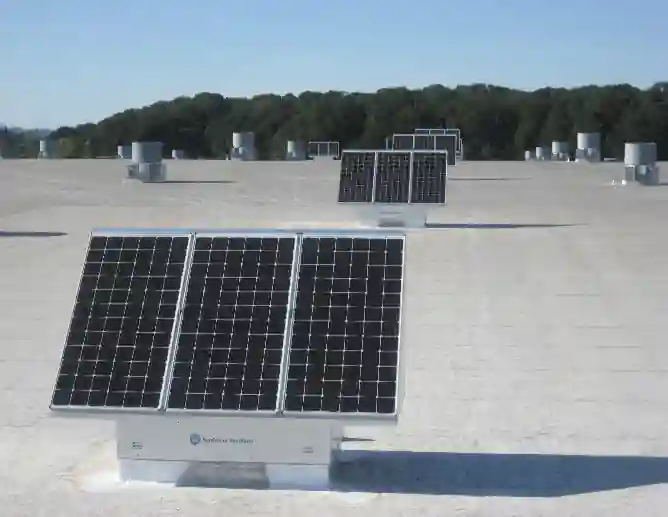
SunCoolers providing continuous high-velocity psychrometric cooling on a high-bay distribution center rooftop.

Psychrometric cooling explained: SunCooler high-velocity airflow allows occupants to tolerate significantly higher temperatures.
How Does the SunCooler™ Provide Real Heat Mitigation?
Traditional HVAC systems try to lower the air temperature itself. The SunCooler™ takes a smarter, more practical approach for large high-bay, industrial, and secure facilities: it delivers massive high-velocity turbulent airflow directly at the occupant level, using the science of psychrometrics to dramatically improve human heat tolerance.
Psychrometric Cooling Through High-Velocity Airflow
When air moves rapidly across the skin it accelerates two powerful cooling mechanisms:
- Convective cooling: Moving air carries body heat away far more efficiently.
- Evaporative cooling: Sweat evaporates faster, producing a strong cooling effect on the skin.
ASHRAE Standard 55 (Thermal Environmental Conditions for Human Occupancy) recognizes that increasing air speed at the occupant level can raise the upper limit of thermal comfort by several degrees Fahrenheit. Air speeds between 0.2 m/s (40 fpm) and 0.8 m/s (160 fpm) are proven to keep people comfortable at significantly higher air temperatures and humidity levels.
The SunCooler achieves exactly this level of performance from a single rooftop unit. Its 36-inch, 5-blade 20° propeller driven by a 1 HP 36V Leeson industrial motor produces up to 15,000 CFM of powerful, turbulent airflow. This high-velocity column penetrates deep into aisles, racking, and occupied zones delivering real psychrometric relief where workers actually are.
Proven in the Toughest Environments: The Submarine Analogy
In submarines and other confined spaces where full HVAC is mechanically or financially impossible, engineers rely on constant high-velocity airflow to allow personnel to tolerate higher temperatures and humidity. The SunCooler brings this same proven strategy to commercial and industrial buildings. By maintaining strong, directed air movement throughout the facility, it provides meaningful thermal relief even when indoor air temperatures remain elevated.
High-velocity airflow dramatically improves human heat tolerance through psychrometric effects (ASHRAE 55).
The SunCooler achieves this using its four fully programmable modes: Exhaust (pulls hot ceiling air out), Induction (pushes cool outside air in), Nightflush (pre-cools the building with nighttime air), and Destratification (circulates air year-round with optional fresh-air mix). All modes are powered by three 575 W solar panels and a 36V lead-acid AGM battery system (210 Ah or 105 Ah) with intelligent limSOC / maxDOD logic that protects the battery while maximizing ventilation.
How We Size SunCooler Deployments for Effective Air Velocities and Quantifiable Heat-Tolerance Gains
Every SunCooler project is engineered around one goal: delivering the right amount of high-velocity turbulent airflow where it matters most which is at the occupant level. We calculate the exact number and placement of units to achieve measurable air velocities that produce real psychrometric cooling gains.
From CFM to Occupant-Level Air Velocity
The SunCooler’s 36-inch, 5-blade 20° propeller and 1 HP Leeson industrial motor deliver up to 15,000 CFM per unit. Because the airflow is highly turbulent and directed downward, it penetrates aisles, racking, and work zones far more effectively than gentle low-speed fans.
We model the facility’s ceiling height, floor layout, and racking density to determine how many SunCoolers are required to produce consistent air velocities of 0.2–0.8 m/s (40–160 fpm) at worker height. These are the exact speeds recognized by ASHRAE Standard 55 as providing significant improvements in heat tolerance.
Scheduling is equally important. We program autonomous events so the SunCooler runs in the right mode at the right time: exhaust and induction during peak daytime heat, nightflush to pre-cool the building’s thermal mass, and destratification in cooler months to keep air moving without introducing unnecessary outside air. The intelligent battery management (limSOC and maxDOD settings) ensures maximum performance even during extended cloudy periods.
The result is a precisely engineered system that delivers quantifiable heat-tolerance improvements across the entire facility all from fully off-grid solar-battery units that require zero wiring or electrical permits.
More About the SunCooler™ as a Heat Mitigation Strategy: Uninterrupted Operation During Grid Brownouts
Heat waves drive massive spikes in air-conditioning demand. When the electrical grid is already stressed, brownouts and rolling blackouts become common exactly when traditional HVAC systems are needed most. The SunCooler™ was designed for this reality.
Fully Off-Grid Solar + Battery = Heat Mitigation That Never Stops
Unlike grid-dependent exhaust fans or HVAC units, every SunCooler operates completely independently on its own solar array and onboard battery system. Three 575 W solar panels charge the 36V lead-acid AGM battery (available in 210 Ah or 105 Ah configurations) while simultaneously powering the 1 HP Leeson industrial motor.
Proprietary battery-management logic (limSOC and maxDOD settings) automatically reduces motor speed as the battery discharges, ensuring the SunCooler continues delivering useful ventilation all day and night even during extended cloudy periods or total grid outages.
- Daytime peak heat: Exhaust and induction modes remove hot stratified air and bring in cooler outside air.
- Nighttime pre-cooling: Nightflush mode floods the building with the coolest available outdoor air, charging the thermal mass for the next day.
- 24/7 air movement: Destratification mode (with optional fresh-air mix) keeps turbulent airflow circulating year-round without relying on the grid.
Because the SunCooler is fully autonomous and programmable, facility teams can schedule any combination of modes and fan speeds throughout the day. When the grid fails, the SunCooler does not. It continues providing the high-velocity psychrometric cooling that keeps occupants safer and more comfortable.
The SunCooler does not compete with existing HVAC systems; but rather, it complements them. By reducing runtime on chillers and heaters, it actually extends the life of legacy equipment while delivering resilient heat mitigation that the grid cannot guarantee.
Works Cited
MLA 9th Edition – North West Renewable Energy Corporation | SunCooler™ Heat-Mitigation Research
- 1. Arens, Edward, et al. “Air Movement as an Energy Efficient Means toward Occupant Comfort.” California Air Resources Board, 1998–2013.
- 2. ASHRAE. “Addendum d to ANSI/ASHRAE Standard 55-2017.” 31 July 2020.
- 3. ASHRAE. ANSI/ASHRAE Standard 55-2020: Thermal Environmental Conditions for Human Occupancy. ASHRAE, 2020.
- 4. Center for the Built Environment. CBE Thermal Comfort Tool. University of California, Berkeley.
- 5. de Dear, R. J., et al. “Convective and Radiative Heat Transfer Coefficients for Individual Human Body Segments.” International Journal of Biometeorology, vol. 40, no. 3, 1997, pp. 141–156.
- 6. Foster, J., et al. “Quantifying the Impact of Heat on Human Physical Work Capacity, Part II: The Observed Interaction of Air Velocity with Temperature, Humidity, Sweat Rate and Clothing Is Not Captured by Most Heat Stress Indices.” International Journal of Biometeorology, 2022.
- 7. Jia, X., et al. “Cooling Effect of Elevated Ambient Air Velocity on Thermal Comfort When Sitting After Walking.” Building and Environment, vol. 225, 2022, p. 109664.
- 8. Tartarini, F., et al. “Application of Gagge’s Energy Balance Model to Determine Humidity-Dependent Temperature Thresholds for Healthy Adults Using Electric Fans During Heatwaves.” Building and Environment, vol. 207, 2022, p. 108437.
- 9. United States Navy. “Chapter 17: Refrigeration and Air Conditioning.” Fleet Submarine – Refrigeration and Air Conditioning Systems.
- 10. Zhou, Jinyue, et al. “Effects of Elevated Air Speed on Thermal Comfort in Hot-Humid Climate and the Extended Summer Comfort Zone.” Energy and Buildings, vol. 287, 2023, p. 112953.
Ready to Deploy the Leading Off-Grid Heat Mitigation Strategy?
Cut heat stress with powerful high-velocity psychrometric cooling, maintain operations during grid brownouts, and complement your existing HVAC all with zero wiring and no electrical permits. North West Renewable Energy Corporation delivers a complete turn-key solution starting from our billable Facility Ventilation Study through manufacturing, installation, staff training, and seamless hand-off to your maintenance team.
Request Heat Mitigation Ventilation Study & Quote →Call Jason in Sales at 503-515-3317 or email jason@nwrec.us or info@nwrec.us
Frequently Asked Questions
1. How does high-velocity airflow actually improve heat tolerance?
The SunCooler delivers powerful turbulent airflow (up to 15,000 CFM) that accelerates convective and evaporative cooling on the skin. ASHRAE Standard 55 shows that air speeds of 0.2–0.8 m/s (40–160 fpm) can raise the upper comfort temperature limit by several degrees Fahrenheit. This psychrometric effect allows occupants to tolerate significantly higher air temperatures and humidity levels without the discomfort or health risks associated with stagnant hot air.
2. Does the SunCooler still provide heat mitigation when the grid goes down?
Yes. The SunCooler is completely off-grid. Three 575 W solar panels and the onboard 36V AGM battery (210 Ah or 105 Ah) keep the 1 HP Leeson motor running even during brownouts or total blackouts. Intelligent limSOC and maxDOD logic automatically adjusts fan speed to protect the battery while still delivering useful ventilation 24/7.
3. How is project sizing determined for effective heat mitigation?
We model each facility’s ceiling height, layout, racking density, and airflow paths to calculate the exact number and placement of SunCoolers needed to achieve target air velocities of 40–160 fpm at occupant level. This ensures quantifiable psychrometric cooling gains across the entire space rather than just moving air near the ceiling.
4. Can the SunCooler work alongside existing HVAC systems?
Absolutely. The SunCooler complements rather than replaces legacy HVAC. Nightflush mode pre-cools the building’s thermal mass overnight, exhaust and induction reduce peak daytime loads, and destratification lowers heating demand in winter all of which reduce runtime and extend the life of your existing equipment.
5. What role does Nightflush play in heat mitigation?
Nightflush uses cool nighttime outdoor air to flush out stored heat and pre-cool the building’s concrete, steel, and other thermal mass. The next day the facility starts with a much lower baseline temperature, delaying the need for mechanical cooling and dramatically improving occupant comfort during peak heat hours.
6. Is the SunCooler eligible for tax incentives or energy rebates?
Yes. SunCooler systems qualify for federal tax deductions under Section 179D of the Inflation Reduction Act for energy-efficient building upgrades. Because incentives vary by location and project type, we include a customized incentive assessment with every Facility Ventilation Study.
7. How secure and IT-friendly is the system for corporate or high-security facilities?
The SunCooler uses a closed local network with short-range WiFi or fully physical USB-only control. There is never an internet or cloud connection. This design meets strict corporate and correctional IT security standards while still providing full scheduling, monitoring, and downloadable performance history.
8. How disruptive is installation to daily operations?
Installation is extremely low-disruption. The SunCooler is a true rooftop drop-in unit: cut the roof penetration, set the unit in place, and activate. Nearly all work occurs on the roof with minimal or zero impact on indoor operations that are typically completed in one to three weeks regardless of facility size.