
Solar Ventilation & Heat Mitigation for Correctional Facilities
Correctional facilities across the U.S. are facing extreme heat crises. With rising temperatures, lawsuits, and increasing pressure from courts and oversight bodies, facility managers need practical, budget-friendly solutions that don’t require major electrical upgrades or security compromises.
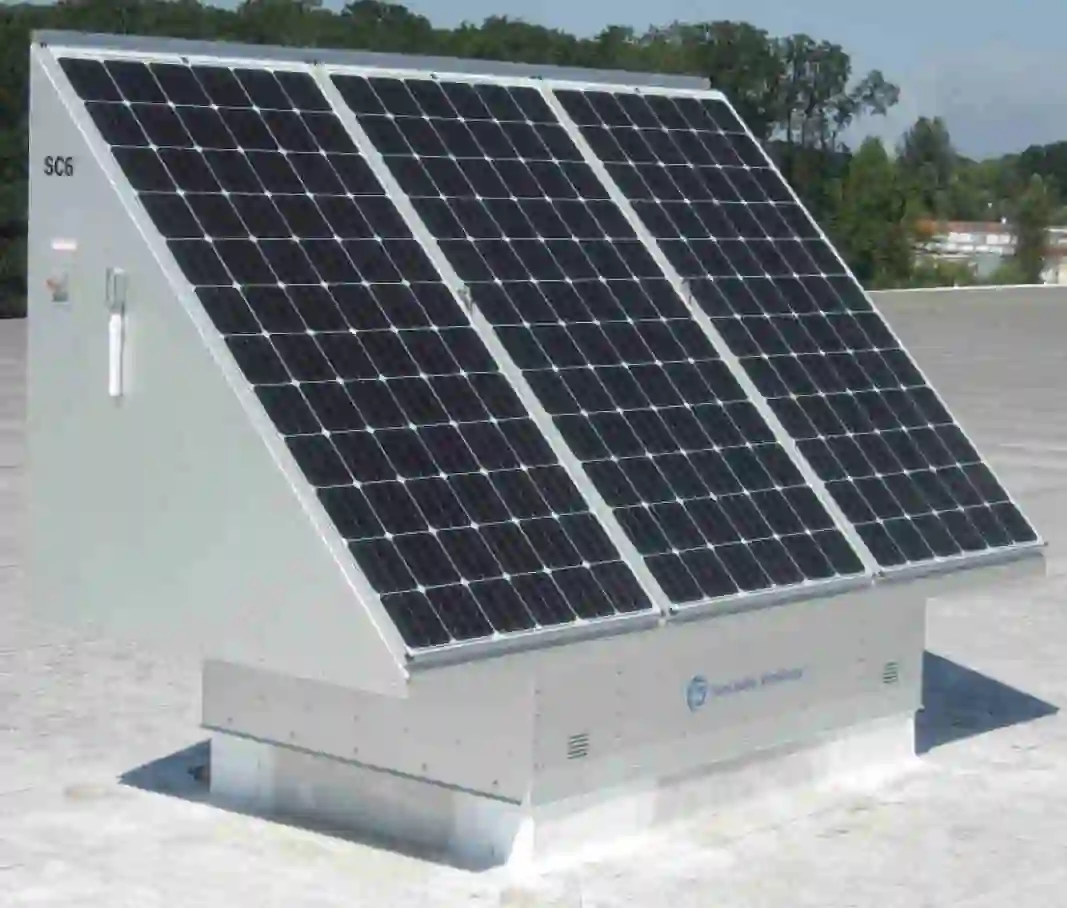
The SunCooler™ is the only fully off-grid industrial-scale solar ventilation HVAC system purpose-built for secure environments. Rooftop installation. No wiring. No electrical permits. It exhausts hot contaminated air and delivers cool night-flush air when it matters most. The SunCooler is the commercial green technology solution for the heat crisis facing federal and state prisons, jails, and correctional facilities by modernizing older structures that were never designed for full HVAC to mitigate heat-related illness and injury among inmates and personnel.
- Affordable and Scalable: A full-facility solution that costs only 1/10th the price of traditional HVAC retrofits with no major electrical upgrades required.
- Works with Existing or Planned HVAC: SunCooler operates standalone and seamlessly supplements existing or planned HVAC systems to greatly improve efficiency and longevity.
- Minimal Disruption and Fast Deployment: Rooftop “drop-in” design means operations continue with almost no interruption. The entire on-site installation phase is typically completed in one to three weeks.
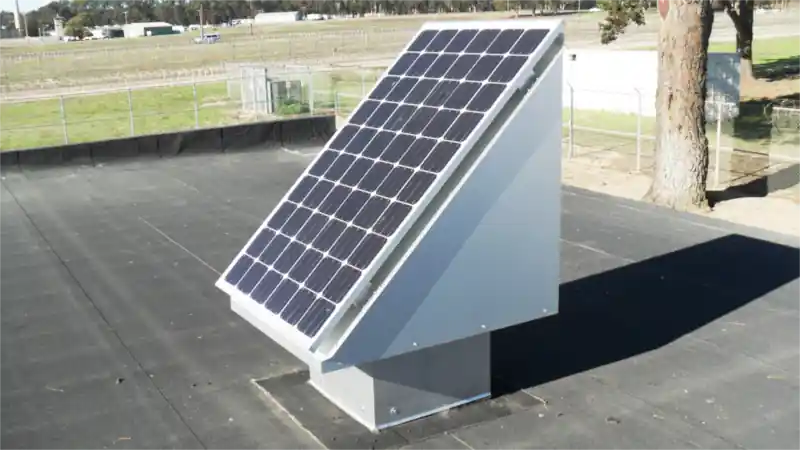
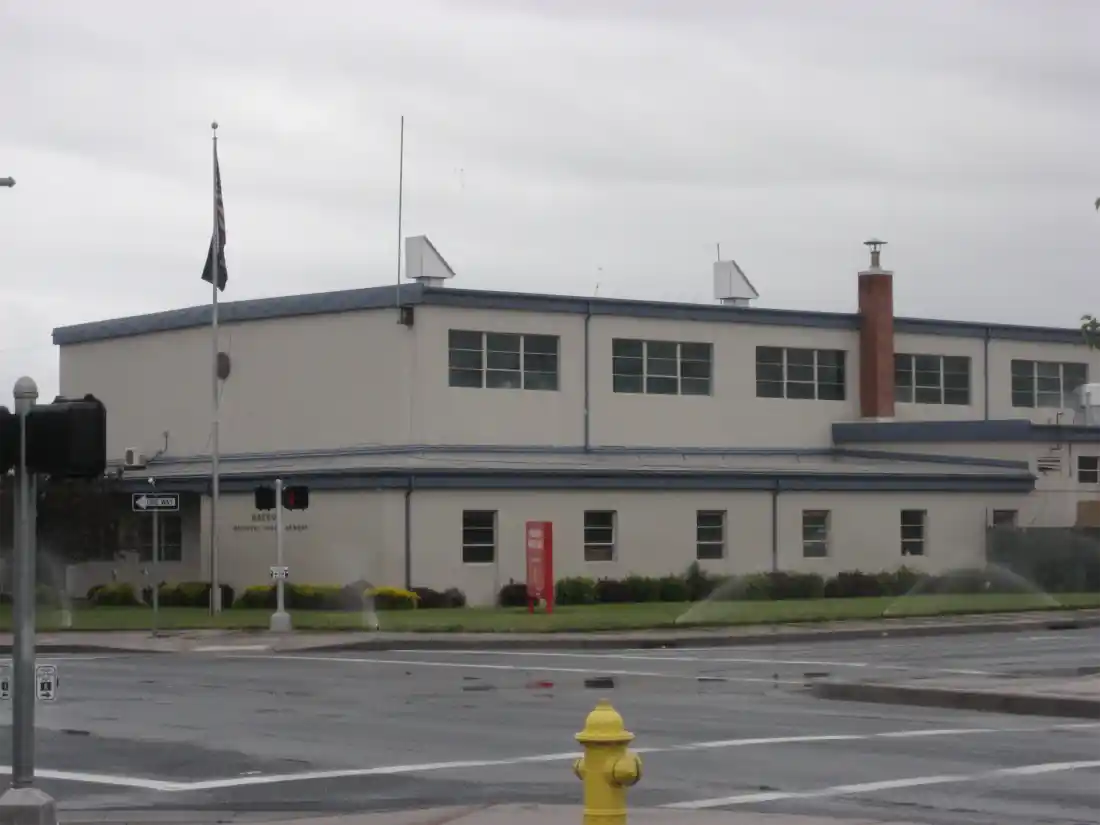
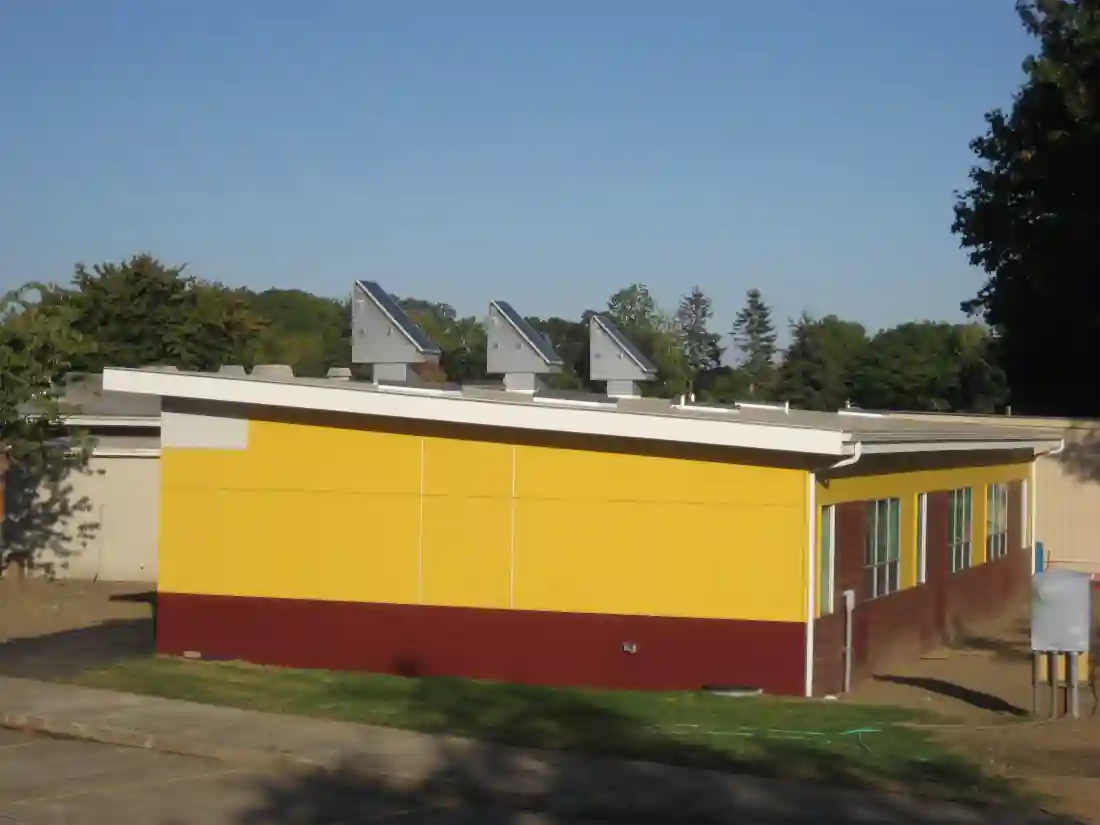
SunCooler on a Federal Bureau of Prisons (BOP) California facility.
The Heat Crisis in Correctional Facilities
Inmates and staff in U.S. correctional facilities regularly endure extreme indoor temperatures exceeding 90-100°F every summer, especially in high-ceiling housing units never engineered for full HVAC.
- Heat-related mortality in prisons rises 5.2–7.4% per 10°F increase; suicide-watch incidents spike up to 22.8% during heatwaves (peer-reviewed studies)
- Texas facilities saw at least 41 deaths linked to the 2023 record heat wave; researchers estimate an average of ~14 heat-associated deaths per year
- 67% of U.S. state and federal prisons recorded summer temperatures above 85°F reinforcing the 8th Amendment lawsuits nationwide
- March 2025: U.S. District Judge Robert Pitman ruled that extreme heat conditions in Texas Department of Criminal Justice (TDCJ) facilities are “plainly unconstitutional” under the 8th Amendment
- 2025: Florida Governor DeSantis vetoed funding for a DOC air-conditioning pilot program, making traditional full HVAC retrofits even more politically and financially difficult and positioning advanced ventilation solutions as the practical, immediate option for heat mitigation in older facilities
¹ Wilson v. Dixon, Case No. 1:24-cv-24253 (S.D. Fla., filed Oct. 31, 2024; class-action claims allowed to proceed May 2025)
² Memorandum Opinion and Order, U.S. District Court, Western District of Texas, March 26, 2025 (Pitman, J.)
³ Governor Ron DeSantis, 2025 General Appropriations Act Veto List (July 2025) – Horizons Community Corp A/C Pilot Program (Miami-Dade facilities)
⁴ PLOS One – Heat-Related Mortality in U.S. Prisons (2023)
⁵ Texas Tribune – 2023 Record Heat Wave Deaths in TDCJ Facilities
⁶ Voices of the Experienced (VOTE) et al. v. James LeBlanc, et al., U.S. District Court, Middle District of Louisiana (ongoing class-action with key heat-protection rulings 2024–2025)
How the SunCooler™ Delivers Practical Heat Mitigation in Correctional Facilities
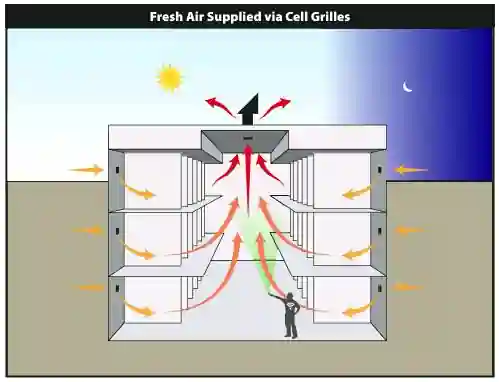
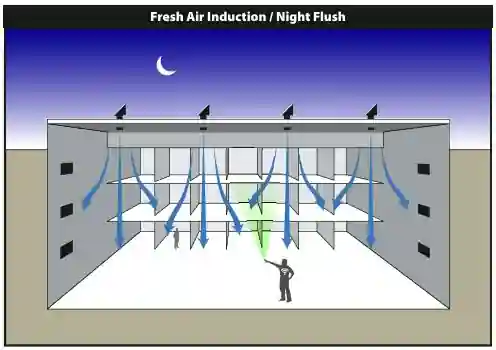
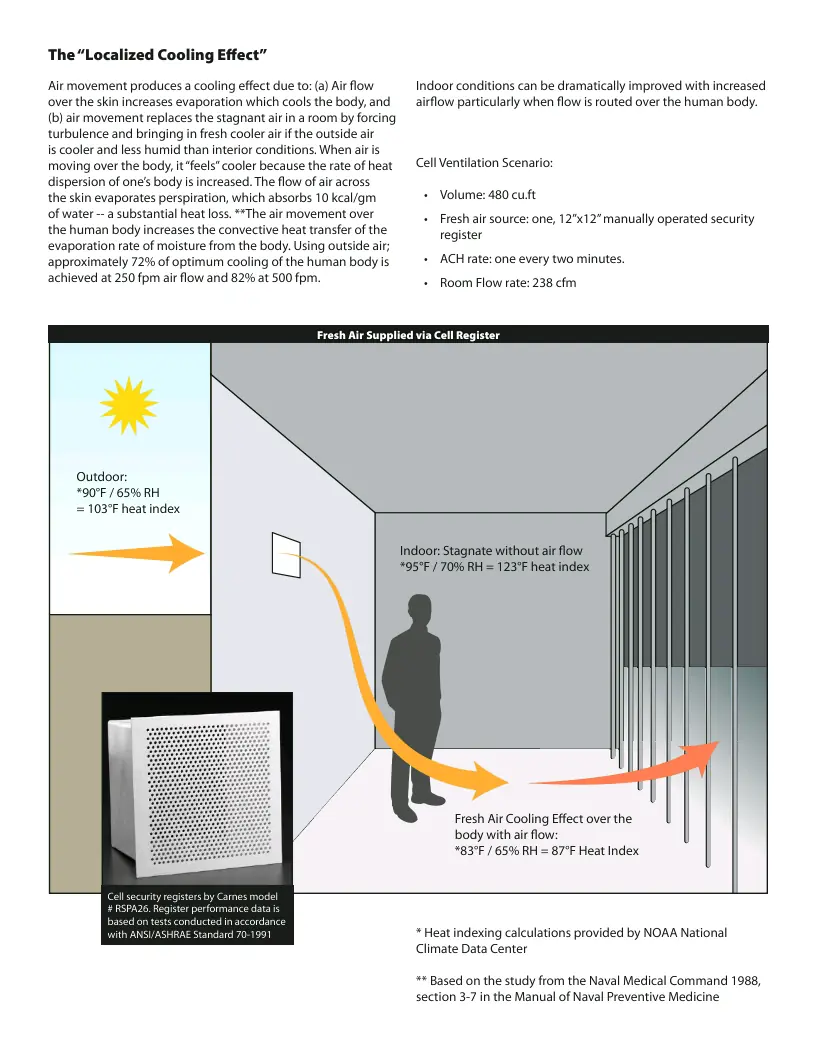
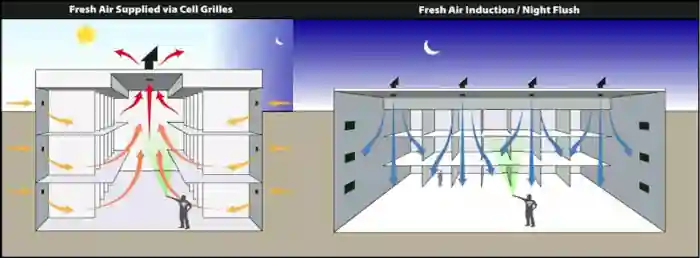
The SunCooler produces significant high velocity airflow throughout a facility. Air velocity over the human body is a component of psychrometry to improve high tempreature tolerance. This science is applied in submarines, for example, where traditional HVAC is infeasible and instead a constant airflow is sustained over the occupants to withstand higher temperature and humidity. Therefore, the SunCoolers provide significant high velocity airflow to provide thermal relief.
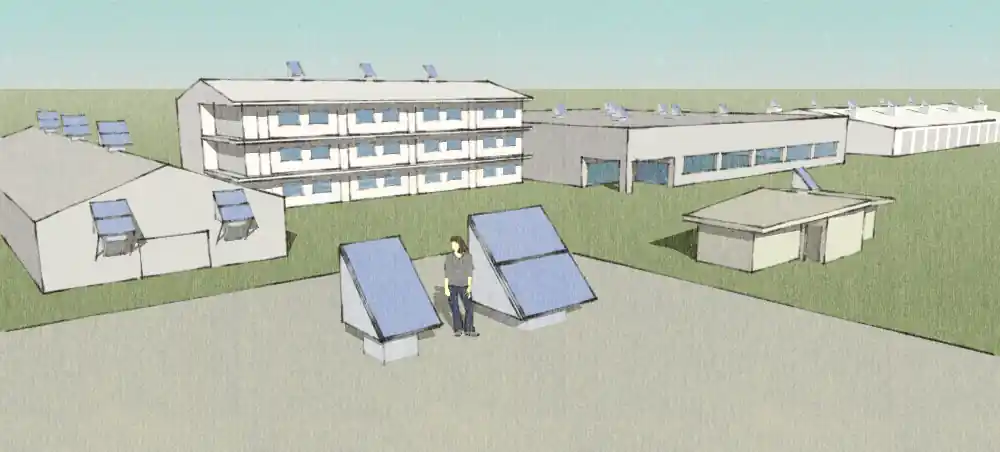
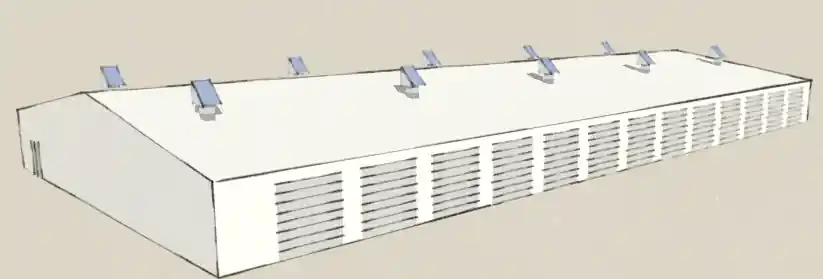
The SunCooler is the fully off-grid solar ventilation HVAC system purpose-built for secure, older, underventilated correctional environments where traditional HVAC is not financially or mechanically feasible just like submarines. For correctional facilities we typically configure SunCoolers for exhaust by day, nightflush at night, with optional but recommended destratification in winter to bring the risen heat down to the occupants. Dozens of SunCoolers, sometimes hundreds throughout a larger installation, will be spread throughout the rooftops with dense clusters at key locations to ensure high velocity airflow reaches its occupants.
Click the link to see more about SunCooler modes of operation and other visuals: SunCooler™

Built for Secure Correctional Environments
Every SunCooler unit stays completely off-grid on the roof. Zero interior wiring. Zero conduit.
Engineered for Maximum Security and Resilience 
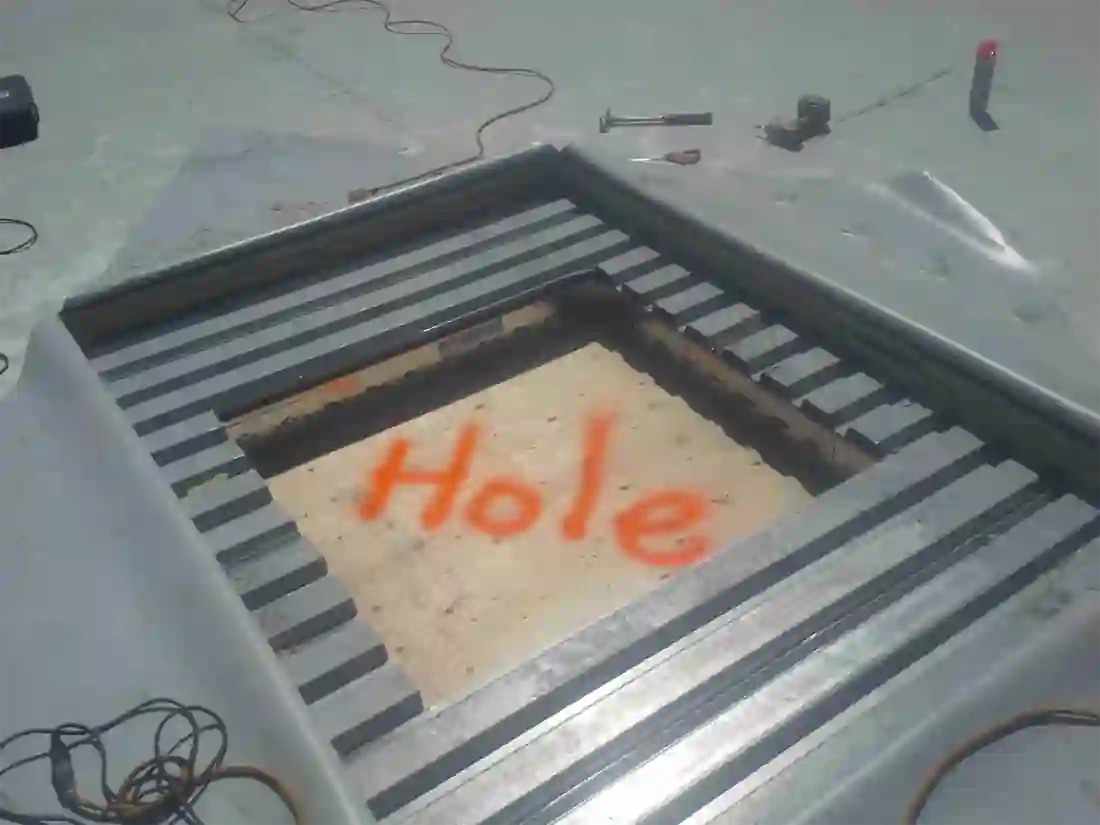
- Rapid, low-disruption rooftop drop-in installation: Simply cut the roof penetration, set the unit in place, and activate. The on-site installation phase is completed in just one to three weeks with almost no impact on daily operations or security protocols.
- Durable aluminum and steel housing with tamper-resistant dampers engineered to resist crawl-through attempts.
- Closed local network
 control using short-range WiFi to a dedicated facility router or fully physical USB-only connection. There is never an internet connection and no cloud exposure of any kind.
 - Full scheduling and real-time environmental monitoring gives you convenient control over facility ventilation with automated schedules for any time of day or night. Each unit also provides downloadable spreadsheet history plus live sensor data that gives your team immediate visibility for extreme-heat safety decisions.
Cut roof penetration for SunCooler Install on a Correctional Facility
Drop the SunCooler into Roof Opening and Activate
Proven Trust & Reliability in Secure Environments
- ✅ Designed and manufactured in the USA: Built specifically for high-security correctional environments
- ✅ No electrical permits required: Fully off-grid solar system with zero interior wiring or conduit
- ✅ Eligible for federal tax incentives: Qualifies under Section 179D of the Inflation Reduction Act for energy-efficient building upgrades
- ✅ Proven rooftop drop-in installation: Minimal disruption to facility operations and security protocols
- ✅ Turn-key service: From Facility Ventilation Study through installation, training, and ongoing support
Ready to Address Heat Mitigation in Your Facility?
Solve your correctional facility’s heat crisis today. Call or email us now. North West Renewable Energy Corporation delivers a complete turn-key solution, from our billable Facility Ventilation Study and detailed quote to full manufacturing, installation, staff training, and seamless hand-off to your maintenance team.
Request Facility Ventilation Study & Quote →Call Jason in Sales at 503-515-3317 or email jason@nwrec.us or info@nwrec.us
Frequently Asked Questions
1. How much does a full SunCooler system cost compared to traditional HVAC?
A complete SunCooler installation project typically costs 1/10th the expense of a traditional full-facility HVAC retrofit. One of the key selling points of the SunCooler is its affordability while addressing heat related challenges.
Traditional HVAC upgrades with chillers, ductwork, and major electrical infrastructure frequently run into the tens of millions of dollars. In contrast, a SunCooler system can deliver effective heat mitigation and ventilation for less than a few million dollars in comparison while completely eliminating the need for expensive electrical upgrades. The system also operates independently of the electrical grid.
SunCoolers have significantly lower long-term operating and maintenance costs, with no major system replacement required for the life of the building.
2. Does the SunCooler require any wiring or electrical work inside the building?
No. The SunCooler is a fully off-grid system that requires zero wiring, conduit, or electrical work inside the building. Each unit is completely self-contained with solar power and battery backup.
This eliminates the need for expensive electrical infrastructure upgrades, making it ideal for older facilities that were never designed for traditional HVAC. The only rare exception is lightning protection in certain climate zones, which involves minimal rooftop cabling to existing systems.
3. Can the SunCooler work alongside our existing HVAC system?
Yes. The SunCooler works alongside existing or planned HVAC systems and actually helps them last longer. By using night-flush cooling, it precools the building’s thermal mass overnight so the HVAC system can start later and run less during the day. It also exhausts hot ceiling air, reducing the load on chillers and cooling equipment.
When equipped with destratification, the SunCooler can reduce heating energy costs by up to 30% during the winter months.
4. How secure is the system from tampering?
The SunCooler operates on a completely closed local network with no internet or cloud connection. Units connect via short-range WiFi to a dedicated facility router and only accept commands through that router using a unique SSID and password. Wireless setup is flexible based on each facility’s requirements.
Because there is no public internet exposure, remote hacking from outside the facility is nearly impossible. Even if someone gained access to the local network, the only realistic action would be basic controls through our SunConfig software.
For maximum security, the wireless module can be omitted entirely, requiring physical USB connection for control. The SunCooler is also built with durable aluminum or steel housing, and the ventilation damper is designed to prevent anyone from crawling through.
5. How disruptive is installation to daily facility operations?
SunCooler installation is typically very low disruption to daily facility operations. Because there is no wiring, conduit, or electrical work required inside the building, each unit is essentially a “drop-in” rooftop installation: cut the roof penetration, set the unit, and activate.
For most facilities, the full installation process takes one to three weeks depending on project scale. Even on larger installations, all work remains limited to the roof with minimal impact on indoor operations. The only exception is when structural bracing is needed from underneath, which is scheduled to avoid disruption.
6. What happens if the batteries fail, will the unit still work?
This depends on the severity of the battery issue. Any failure that poses a safety risk will cause the SunCooler to safely shut down via built-in sensors and protection systems. Otherwise, the unit can continue operating on solar power alone during daylight hours, though nighttime operation will gradually decline as batteries degrade.
For optimal heat mitigation in correctional facilities, we strongly recommend maintaining the batteries to preserve full night-flush cooling capability. Even if neglected, the SunCooler will still provide effective daytime ventilation during hot summer days.
7. Is the SunCooler eligible for any government funding, grants, or tax credits?
Yes, SunCooler systems are often eligible for government funding, grants, and tax incentives, though eligibility varies by location and project type.
The most common applicable programs include federal tax deductions under the Inflation Reduction Act (Section 179D) for energy-efficient commercial building upgrades, as well as various state-level energy efficiency grants and rebates.
Because funding availability and qualification requirements change frequently and differ by state and facility type, we recommend contacting us directly for a current assessment of available incentives for your specific project.
8. Can this system help reduce the risk of heat-related lawsuits or meet state mandates?
Yes. The SunCooler is specifically designed to address heat mitigation challenges in correctional facilities. By reducing extreme indoor temperatures and improving ventilation, it helps facilities meet state heat mitigation mandates and significantly improves conditions for both staff and inmates.
Many correctional systems are facing increasing legal pressure and lawsuits related to extreme heat. Installing SunCoolers demonstrates proactive steps to reduce heat-related risks and can support compliance with emerging standards and court requirements.