
CO₂ Regulation & Indoor Air Quality (IAQ) with SunCooler™ Industrial Solar Ventilation
Large high-bay warehouses, distribution centers, manufacturing plants, and other industrial facilities frequently develop stagnant “dead zones” where CO₂, VOCs, product off-gassing, welding fumes, vehicle exhaust, and dust accumulate. Employees report the classic “sick from the air” feeling, headaches, fatigue, reduced concentration, and lower productivity which is exactly what happens when CO₂ levels reach 1,000–2,000 ppm.
The SunCooler™ is the only fully off-grid industrial solar air handling system that solves this problem at the source. In destratification mode, its built-in indoor CO₂ sensor continuously monitors levels and automatically introduces a precise 0–100% fresh-air mix while still delivering powerful high-velocity turbulent airflow. Combined with dedicated exhaust mode, the SunCooler actively removes contaminants and prevents settling all without wiring or electrical permits.
- CO₂-Regulated Fresh Air Mix: Destratification mode with autonomous damper control maintains optimal CO₂ levels (e.g., 1,200 ppm setpoint) while continuing to mix and destratify the space.
- High-Velocity Dead-Zone Elimination: Turbulent airflow breaks up stagnant pockets far more effectively than HVLS fans, preventing CO₂ and contaminant buildup before fresh air is even needed.
- Source Exhaust & Contaminant Removal: Powerful exhaust mode pulls VOCs, fumes, dust, and vehicle exhaust directly out of the building at the source.
- Fully Autonomous 24/7 Operation: SunConfig GUI provides live CO₂, temperature, humidity, and pressure monitoring with programmable scheduling and downloadable history all on a closed local network.
For a clear breakdown of how different CO₂ levels affect occupants, see the CO₂ Indoor Levels Chart.
See exactly how the SunCooler™ regulates CO₂ and improves IAQ →
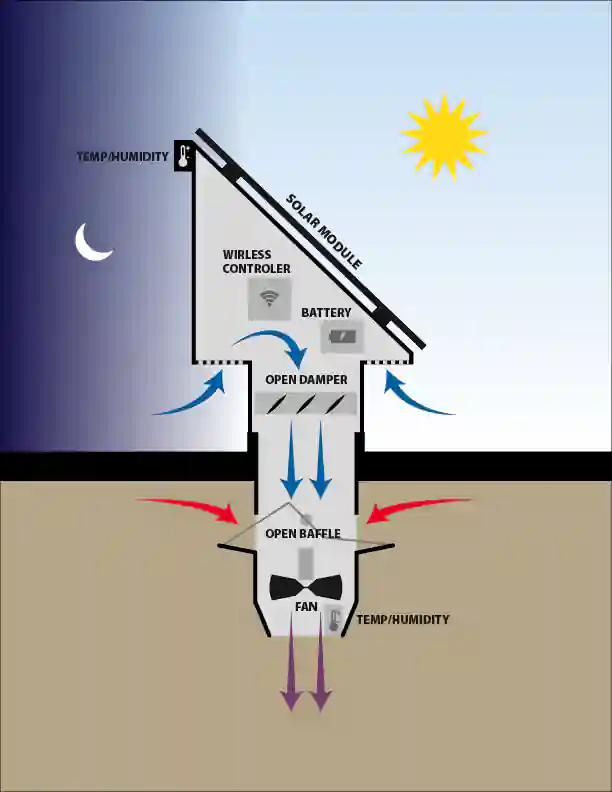
SunCooler™ performing destratification with programmable CO₂-regulated fresh-air mix.
Fog demo of SunCooler™ destratification. Note: Video has no audio.
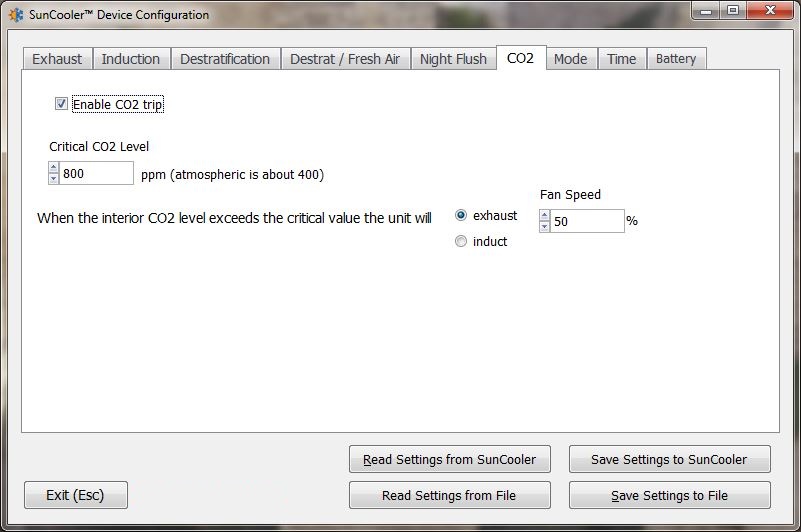
The SunConfig screen to configure CO2 settings.
CO₂ Concentration Levels & Health Effects
Source: co2meter.com – Carbon Dioxide Indoor Levels Chart
Most facilities target under 1,000 ppm (ideally below 800 ppm in offices/classrooms). The SunCooler’s CO₂-regulated fresh-air mix is specifically designed to keep your facility in the green “acceptable” zone automatically.
How the SunCooler™ Precisely Regulates CO₂ Levels
The SunCooler™ regulates CO₂ using its destratification mode combined with an optional factory-installed indoor CO₂ sensor and a modulating fresh-air damper. Note: The CO₂ sensor is an optional module. The SunCooler still delivers excellent air movement and IAQ improvement through destratification and exhaust without the sensor. To ensure regulation with facilities known to have stale air, deadzones, and CO2 challenges then the CO₂ module is installed allowing the SunCooler to react to rising CO₂ levels.
Core CO₂ Regulation Mechanism
In normal destratification mode the SunCooler seals off outdoor air and recirculates indoor air, pushing warm ceiling air down to the occupied zone. When the optional CO₂ sensor detects levels rising above your programmed setpoint (commonly 1,000–1,200 ppm), the system automatically begins opening the fresh-air damper from 0–100%.

SunCooler™ internal sealed damper can partially open for fresh air mix.
Fresh outside air is introduced gradually and proportionally: only the exact amount needed to bring CO₂ back down while the high-velocity fan continues full destratification. This delivers targeted dilution of CO₂ without losing the thermal mixing benefits that make destratification so effective.
SunCooler™ in destratification mode with autonomous CO₂-regulated fresh-air mix.
How to Configure CO₂ Regulation in SunConfig
All CO₂ settings are configured wirelessly (or via USB) through the intuitive SunConfig GUI:
- Open SunConfig and wirelessly connect (or USB) to a SunCooler.
- Navigate to Configure → CO2.
- Enable CO₂ Control and enter your desired trip point (example: 1,200 ppm).
Once set, the system operates completely autonomously. You can view live CO₂ readings, historical trends, and download performance data at any time.

SunConfig entry screen: select configure -> CO2 to configure CO2 settings.
The SunConfig screen to configure CO2 settings.
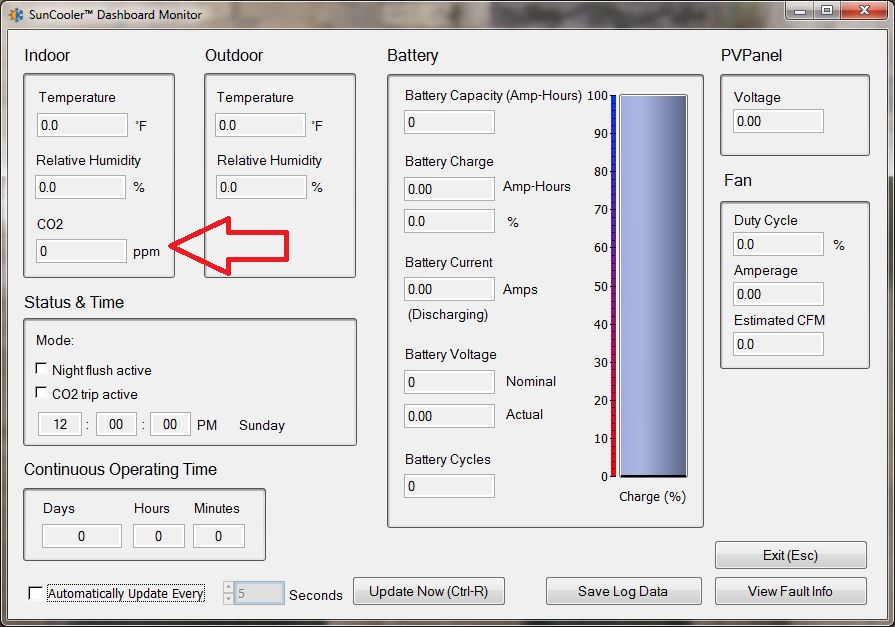
SunConfig monitor screen showing live CO₂ levels.
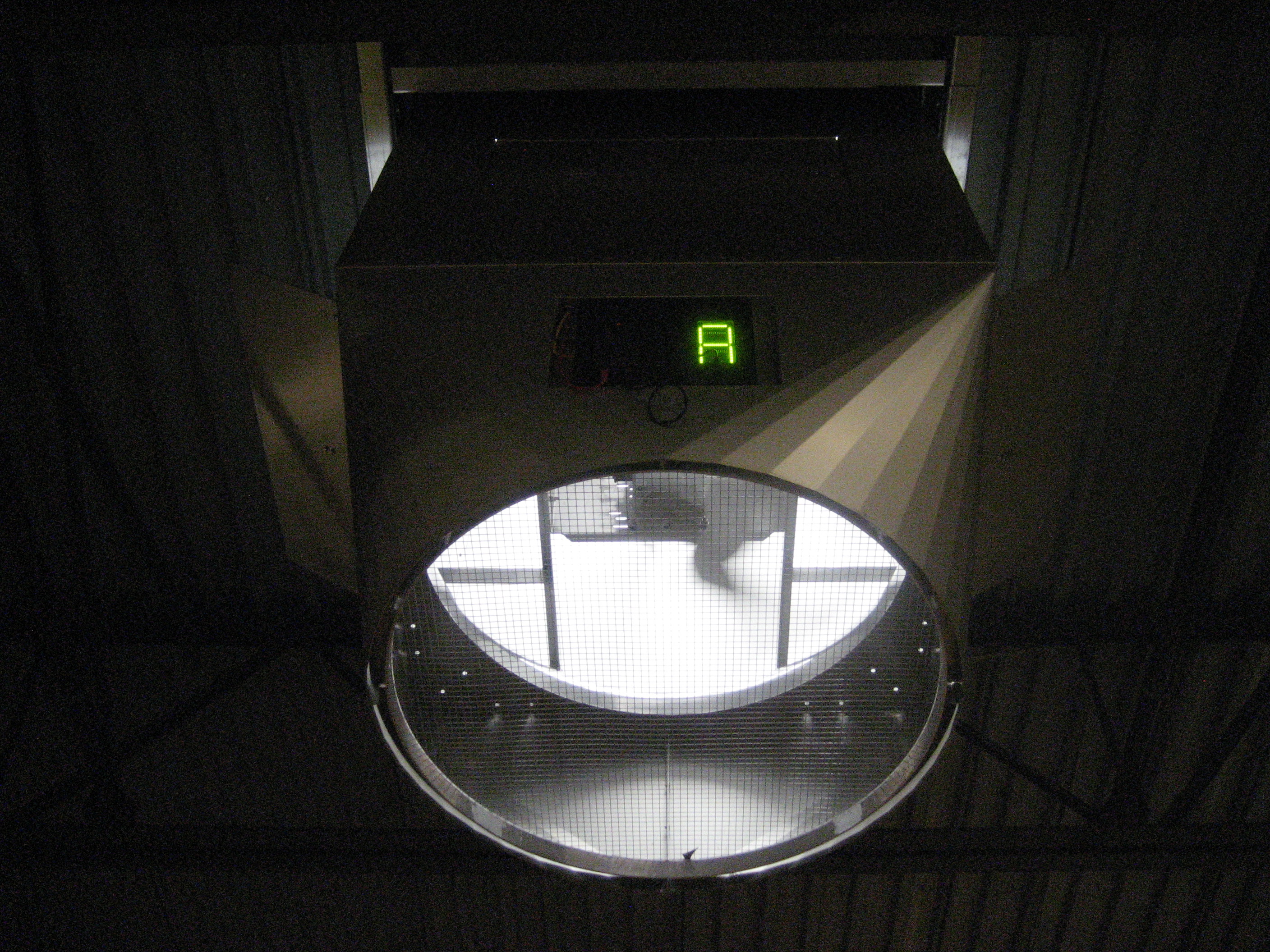
SunCooler destratifying with partial fresh air mix, outdoor light visible through open internal damper. LED shows "A" for automatic operation.
Does CO₂ Regulation Affect Indoor Temperature or Humidity?
No: the system prevents conflicts. The SunCooler has independent temperature and humidity sensors in addition to the CO₂ sensor. You define individual setpoints and priority order in SunConfig. The controller intelligently balances all three parameters so CO₂ regulation never overrides your temperature or humidity targets, nor does it conflict with existing HVAC setpoints.
Next: How the SunCooler also improves overall Indoor Air Quality →
Exhaust Mode & High-Velocity Airflow for Superior Indoor Air Quality
While CO₂ regulation handles dilution through controlled fresh-air mixing, the SunCooler™ also delivers powerful active contaminant removal and prevention through its exhaust mode and high-velocity turbulent airflow; capabilities that go far beyond what gentle destratification or HVLS fans can achieve.
Exhaust Mode – Direct Source Removal of Airborne Contaminants
In exhaust mode the SunCooler rapidly pulls hot, contaminated air out through the ceiling while creating powerful negative pressure that draws fresh air in through doors, louvers, and wall vents. This mode is ideal for removing:
- VOCs and product off-gassing
- Welding fumes and industrial process emissions
- Vehicle exhaust from forklifts and loading docks
- Dust, dander, and airborne pathogens

SunCooler™ in exhaust mode actively removing VOCs, fumes, dust, and other airborne contaminants.
High-Velocity Turbulent Airflow Prevents Settling and Breaks Up Dead Zones
Even in destratification mode, the SunCooler’s 15,000 CFM high-velocity turbulent air column does much more than move air, it aggressively breaks up stagnant pockets and prevents airborne particles from settling on stored product, racking, or work surfaces. Unlike low-speed HVLS fans that allow contaminants to drift and deposit, the SunCooler creates strong turbulent eddies that keep dust, fumes, and particulates suspended and moving toward exhaust points.
Superior Rack & Aisle Penetration vs. HVLS Fans
In rack-dense warehouses and distribution centers, HVLS fans often produce a gentle radial flow that deflects around tall racking. The SunCooler’s downward high-velocity column penetrates deep into aisles and rack levels, delivering effective airflow where it is needed most. This dramatically reduces localized contaminant buildup and improves overall indoor air quality throughout the entire facility.
The result is cleaner air, reduced product contamination risk, fewer employee complaints about “stale” or “sick” air, and better compliance with IAQ standards all from the same off-grid rooftop units that also regulate CO₂.
Ready to improve both CO₂ control and overall indoor air quality? →
Ready to Improve CO₂ Control and Indoor Air Quality in Your Facility?
Eliminate stagnant dead zones, automatically regulate CO₂ levels, and actively remove VOCs, welding fumes, dust, and other airborne contaminants all with the fully off-grid SunCooler™. North West Renewable Energy Corporation delivers a complete turn-key solution starting with our billable Facility IAQ & CO₂ Ventilation Study through manufacturing, installation, staff training, and seamless hand-off to your team.
Request Facility IAQ & CO₂ Ventilation Study & Quote →Call Jason in Sales at 503-515-3317 or email jason@nwrec.us or info@nwrec.us
Frequently Asked Questions – CO₂ Regulation & Indoor Air Quality
1. How does the SunCooler™ actually regulate CO₂ levels?
In destratification mode the SunCooler normally recirculates indoor air. When the optional indoor CO₂ sensor detects levels rising above your programmed setpoint (typically 1,000–1,200 ppm), the system automatically opens the fresh-air damper from 0–100%. It introduces precisely the amount of outside air needed to dilute CO₂ while continuing high-velocity destratification. The process is fully autonomous and proportional with no sudden blasts of cold or hot air.
2. What CO₂ setpoint should I use?
Most facilities set the trip point between 1,000 and 1,200 ppm. According to the CO₂ Indoor Levels Chart, levels above 1,000 ppm commonly produce the “sick from the air” feeling, headaches, and reduced concentration. You can adjust the setpoint in SunConfig at any time based on your specific operations and employee feedback.
3. Does bringing in fresh air for CO₂ control affect my indoor temperature or humidity?
No. The SunCooler has independent temperature and humidity sensors in addition to the CO₂ sensor. You set priority logic in SunConfig so the controller always respects your temperature and humidity setpoints first (or balances them intelligently). The system only introduces the minimum fresh air required for CO₂ control and never overrides existing HVAC setpoints. Clients are encouraged to reach out to NWREC for tech support if this presents a challenge which is not uncommon..
4. Is the CO₂ sensor required on every unit?
No. the CO₂ sensor is an optional factory-installed module. Many customers choose not to include it if their primary goal is general air movement and destratification. The SunCooler still provides excellent IAQ performance through high-velocity destratification and exhaust even without the CO₂ option.
5. Can the SunCooler handle welding fumes, VOCs, vehicle exhaust, and dust?
Yes. In exhaust mode the SunCooler creates powerful negative pressure that rapidly removes welding fumes, VOCs from product off-gassing, forklift exhaust, and dust at the source. Even in destratification mode its high-velocity turbulent airflow prevents particles from settling on racking and stored product for a major improvement over gentle HVLS fans.
6. How does the SunCooler compare to HVLS fans for indoor air quality?
HVLS fans provide gentle, low-velocity circulation that often allows contaminants to settle and fails to penetrate deep into rack aisles. The SunCooler delivers high-velocity turbulent airflow (up to 15,000 CFM) that breaks up dead zones, keeps particles suspended, and penetrates racking far more effectively while also offering true exhaust and CO₂-regulated fresh-air mix. Check out our comparison page on this topic: SunCooler vs Big Ass Fans and Solair
7. Does the SunCooler replace dedicated ventilation or make-up air systems?
The SunCooler can replace all grid powered rooftop exhaust fans and often significantly reduces the need for additional systems, but it works beautifully alongside them too. Many facilities use SunCoolers as the primary IAQ solution. The SunCooler handles the bulk of CO₂ dilution and contaminant removal across the entire facility.
8. How do I monitor CO₂ and IAQ performance across the whole facility?
Through the SunConfig GUI you get live readings of CO₂, temperature, humidity, and pressure from every unit. You can view historical trends, download spreadsheet data, and set up automated alerts. For very large sites you can monitor and control hundreds of SunCoolers from a single laptop on the closed local network.
9. Is the system secure for corporate or high-security facilities?
Yes. The SunCooler uses a completely closed local network with short-range WiFi or fully physical USB-only control. There is never an internet or cloud connection. This design meets strict corporate IT and correctional security standards.
10. Does the SunCooler qualify for energy efficiency or IAQ incentives?
Yes. SunCooler systems typically qualify under Section 179D of the Inflation Reduction Act for energy-efficient building upgrades. Many utilities and states also offer rebates for projects that improve indoor air quality and reduce grid-powered ventilation. We provide a customized incentive assessment with every Facility IAQ & CO₂ Ventilation Study.
11. How scalable is the system for very large facilities?
Extremely scalable. A single regional distribution center or manufacturing plant often uses 50–200+ units. The modular design and centralized SunConfig monitoring make it simple to manage hundreds of SunCoolers across multiple buildings from one laptop.
12. What maintenance is required for the CO₂ sensor?
The optional CO₂ sensor is factory-calibrated and requires minimal maintenance. Like the batteries, it is easily accessible from the roof. We recommend periodic checks (typically every 2–3 years) as part of routine SunCooler service. Daytime solar operation continues even if sensors need attention.